Running a scrap metal operation means every load counts. The trailer behind your truck directly affects your profit on every haul. Choosing the wrong one costs you money every single day. Choosing the right one pays for itself fast.
This guide covers exactly what scrap metal recyclers need to know. We will walk through payload, lift capacity, frame design, and safety. Furthermore, we will explain why frameless trailers carry real risks in scrap applications. By the end, you will know which trailer is right for your operation.
Why Scrap Metal Is the Toughest Test for Any Trailer
Most buyers think about box size first. However, scrap metal does not work like other materials. Scrap is dense, heavy, and unpredictable by nature. A container full of light iron or shredded steel hits legal weight limits fast. You run out of legal payload long before you run out of box space.
That changes everything about what your trailer needs to do. Therefore, you need maximum legal payload above all else. You also need a frame built to handle punishment day after day. Additionally, you need a hoist that lifts heavy loads without strain every time.
The wrong trailer leaves money on the ground. The right one makes you more competitive immediately.
What to Look for in a Scrap Metal Roll-Off Trailer
- Payload Capacity
Payload is the most important number for any scrap operation. It is your gross vehicle weight limit minus the weight of your truck and trailer. In most states, that limit is 80,000 lbs gross vehicle weight. BENLEE also make trailers up to 154,000 GVW for Michigan.
Every pound your trailer weighs is a pound of scrap you cannot haul legally. Therefore, a lighter trailer means more payload on every single load. Over thousands of hauls per year, that difference adds up to serious revenue.
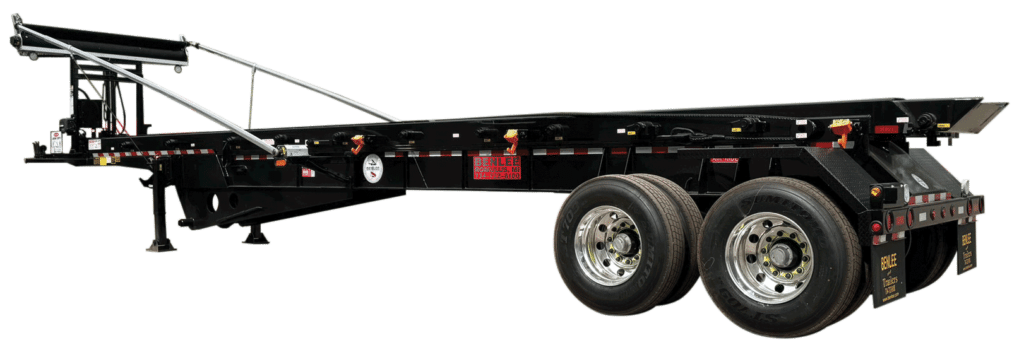
The BENLEE Bridge Master was engineered specifically to solve this problem. Its bridge-style frame runs along the outside edges of the trailer. As a result, it eliminates unnecessary steel weight without sacrificing any structural strength. This gives scrap operators maximum legal payload on every load they run.
Always ask any manufacturer for the actual tare weight of their trailer. Then calculate your real-world payload at 80,000 GVW. Furthermore, compare that number directly against competitors before you decide.
-
Lift Capacity
Scrap metal loads are among the heaviest in the industry. A container of dense ferrous scrap can easily reach 25,000 to 30,000 lbs or more. Reports of over 135,000 lbs have been reported in Michigan. Your hoist must handle that weight reliably, every day, without any strain.
BENLEE Roll-off trailer product line
BENLEE trailers are built with lift capacity designed for heavy scrap applications. The Super Mini and Bridge Master are specifically engineered for high-payload environments. Consequently, they handle the demands of scrap yard work without breaking down.
Always ask any manufacturer for their rated lift capacity. Then compare it directly to the loads you typically run. A trailer that cannot handle your loads will show weakness within months.
-
Frame Strength and Durability
Scrap metal is not just heavy — it is punishment for your equipment. Pieces shift during transport and create uneven stress on the frame. Loads dump unevenly and containers come back with dents and stress points accumulated over time.
Your frame must handle this abuse for years, not just months. BENLEE uses high-strength steel and proprietary engineering developed over 50 years of manufacturing. Additionally, the Bridge Master frame distributes load stress across the entire structure. This prevents stress from concentrating at weak points over time.
BENLEE backs every trailer with the longest frame warranty in the industry: six years. Competitors offer one to five years. Therefore, ask yourself what a shorter warranty tells you about their confidence.
-
Framed vs. Frameless — The Truth for Scrap Operations
This is one of the most important decisions you will make. Furthermore, it is one where the industry does not always tell you the full story. Here is an honest comparison based on engineering facts.
The Frameless Trailer — What Manufacturers Don’t Tell You
Frameless trailer manufacturers claim their units are lighter and carry more payload. In theory, this sounds correct. However, the real-world picture is more complicated — and more dangerous.
The weight claim does not hold up fully. Frameless trailers require a subframe linked to the truck cab. That subframe adds significant weight back into the equation. As a result, the payload advantage shrinks considerably once you account for the subframe weight.
On many units axles lift off the ground on frameless trailers. Because there is no frame, weight distribution changes dramatically under load. On some frameless trailers, one to five axles lift off the ground when carrying heavy loads. Therefore, all that weight transfers onto the remaining axles and tires. In many cases this over-pressurizes the tires beyond their rated capacity. Over time, this causes premature tire failure and serious safety risk.
The center of gravity rises dangerously on a frameless trailer. With no frame to distribute load low and wide, the center of gravity moves upward. Consequently, the trailer becomes less stable — especially on uneven ground or during dumping. This is a critical issue for scrap yard operations where surfaces are rarely perfectly level.
The trailer loses its stance under load. On a frameless design, the rear axles shift toward the drive axles when weight is applied. As a result, the trailer loses its footprint — the wide, stable base that keeps it grounded. A narrower footprint means less stability during loading, dumping, and transport.
The single-point suspension beam was never designed for this. Frameless trailers concentrate tens of thousands of pounds of force on a single-point suspension beam. However, that beam was not engineered to serve as the pivot point for that kind of load. Neither was the king pin plate, which also absorbs stress it was not designed to handle. Over time, this causes accelerated wear and structural risk on the truck cab and subframe.
Some steel mills ban frameless trailers entirely. This is not a marketing claim — it is an operational reality. Some steel mills do not allow frameless roll-off trailers on their property. The reason is straightforward: when loads shift during dumping, frameless trailers are prone to tipping over. Consequently, mill operators have decided the risk is not worth it. If your operation serves steel mills or scrap processors with similar policies, a frameless trailer may disqualify you from those accounts.
The BENLEE Bridge Master — Built for Scrap
The Bridge Master solves every one of these problems through engineering. Here is how it compares directly.
The bridge is 20 inches longer than competing frameless designs. That extra 20 inches of bridge length adds approximately 1,300 lbs of additional legal payload capacity compared to an ACE frameless trailer. Therefore, you carry more per load — not less — with the Bridge Master framed design.
All axles stay on the ground. The Bridge Master frame distributes load weight evenly across all axles. As a result, no axle lifts off the ground, no tire gets over-pressurized, and your equipment lasts longer.
The center of gravity stays low. The frame keeps the load distributed low and wide across the trailer structure. Consequently, the Bridge Master is far more stable than a frameless design — especially during dumping on uneven scrap yard surfaces.
The trailer keeps its full footprint. Because the frame holds the structure rigid, axle spacing does not shift under load. Therefore, the Bridge Master maintains its full stance and stability in every operating condition.
No stress on components not built for it. The Bridge Master’s frame carries the load — not the suspension beam, not the king pin plate, and not the truck cab subframe. Furthermore, there is no subframe required on the truck at all. The Bridge Master hooks to any standard semi-tractor immediately.
Steel mills allow it. Because the Bridge Master is a framed design with proven stability underload, it is welcome at steel mills and processors that restrict frameless trailers. Additionally, this gives BENLEE customers access to accounts that frameless trailer operators cannot serve.
Container Considerations for Scrap Metal
The trailer is only part of the equation. The container you pair with it matters too.
Smaller containers often make more sense for scrap. Because scrap metal is so dense, a 20-foot container can reach legal weight before it looks full. Therefore, running larger containers does not automatically mean more payload. It can mean more container weight with no added scrap capacity.
Open-top containers are essential. You need to load from above with a crane, magnet, or loader. Furthermore, open-top containers with reinforced walls handle the impacts of scrap loading better than standard designs.
Inspect containers regularly. Scrap metal is hard on containers. Reinforce floors in containers running heavy dense loads. Additionally, inspect walls ground rollers, nose rollers and corners for damage that builds up over time.
Nose rollers and ground rollers]
BENLEE can advise on the right container pairing for your specific operation. Matching the right container to your trailer is one of the most overlooked opportunities in the industry.
The Cost of Getting the Trailer Decision Wrong
Here is a real-world example that makes the math clear.
Say your operation runs 10 loads per day, five days a week. Your truck and trailer weigh 40,000 lbs combined. Therefore, you have 40,000 lbs of legal payload per load.
Now say you chose a heavier competitor trailer that weighs 1,300 lbs more than a Bridge Master. You just lost 1,300 lbs of payload per load. At 10 loads per day, that is 13,000 lbs of scrap you cannot haul daily. At $200 per ton for shredded steel, that is $1,300 per day in lost revenue. Over a 250-day work year, that is $325,000 in lost revenue annually.
Furthermore, if a frameless trailer causes a tip-over incident at a steel mill or scrap yard, the costs go far beyond lost payload. Consequently, the total cost of the wrong trailer decision is far higher than most buyers realize upfront.
Why BENLEE Is the Right Choice for Scrap Metal Recyclers
BENLEE has been manufacturing roll-off trailers since 1974. Moreover, the company was founded in 1971 as a scrap metal broker. That is not a coincidence — BENLEE understands the scrap industry from the inside out.
Key advantages for scrap metal operators include:
- Maximum legal payload through Bridge Master engineering — 1,300 lbs more than ACE frameless
- All axles stay grounded — no tire over-pressurization
- Stable center of gravity — safer on uneven scrapyard surfaces
- Full trailer footprint maintained under load at all times
- No subframe required — hooks to any standard semi-tractor
- Allowed at steel mills that restrict frameless trailers
- Six-year frame warranty — longest in the industry
- 30+ year service life vs. industry standard of 12-15 years
- Same-day parts shipping from BENLEE’s parts superstore
Roll off trailer and roll off truck parts Super Store
BENLEE also offers the Super Mini for urban scrap yards or tighter routes. Additionally, the Two Container trailer is purpose-built for long-haul environmental operations.
Two container trailer, double rail roll off trailer
Questions to Ask Before You Buy
Before finalizing any roll-off trailer purchase for your scrap operation, get clear answers to these:
- What is the actual tare weight — not an estimate?
- What is the rated lift capacity for my typical loads?
- Do all axles stay on the ground under full load?
- What does the warranty cover and for exactly how long?
- Are your trailers allowed at steel mills and scrap processors?
- What is parts availability and lead time if something breaks?
- Can I speak with current customers running scrap operations like mine?
BENLEE answers every one of these questions directly. Furthermore, BENLEE customers can speak with real operators running the same applications. Call 734-722-8100 or visit benlee.com to speak with a specialist today.
Contact BENLEE — BENLEE Roll offs
The Bottom Line
The best roll-off trailer for scrap metal recycling is not the lightest one on paper. It is the one that maximizes your real legal payload, keeps all axles grounded, maintains stability during dumping, and holds up for decades of hard use.
Furthermore, it is the one that keeps you working at every customer site — including the ones that ban frameless trailers entirely.
For scrap metal recyclers, that trailer is the BENLEE Bridge Master. It carries more weight than competing frameless designs, stays stable under the most demanding loads, and is backed by the industry’s only six-year frame warranty.
Call BENLEE at 734-722-8100 or visit benlee.com today.
BENLEE Manufacturing is a Michigan-based roll-off trailer manufacturer serving scrap metal recyclers, waste haulers, demolition contractors, and environmental operators across the United States, Canada, and Mexico since 1974. Founded as a scrap metal broker
Greg Brown
734-722-8100
greg.brown@benlee.com