
The Complete Guide to Roll-Off Trailers: Everything You Need to Know
If you haul scrap metal, construction debris, demolition waste, or recyclables, the roll-off trailer is one of the most important pieces of equipment in your fleet. Choosing the right one affects your payload capacity, operating costs, safety record, and bottom line for years to come.
This guide covers everything operators, fleet managers, and business owners need to understand about roll-off trailers — from how they work and the different types available, to key specifications that separate a good trailer from a great one. Whether you’re buying your first unit or expanding a fleet of fifty, this resource will help you make a more informed decision.
What Is a Roll-Off Trailer?
A roll-off trailer is a heavy-duty semi-trailer designed to transport large open-top containers (commonly called roll-off boxes or dumpsters) using a cable hoist system. The trailer’s hydraulic-powered hoist lifts, tilts, and rolls containers on and off the trailer bed, allowing a single driver to load, transport, and deposit containers without additional equipment like cranes or forklifts.
Roll-off trailers are pulled by standard semi-tractors, which gives them a significant advantage over truck-mounted roll-off systems: the tractor can be disconnected and used for other tasks while containers are loaded or unloaded on-site. This flexibility makes roll-off trailers the preferred choice for operations that need to maximize equipment utilization. This is a decoupling of assets.
The term “roll-off” refers to the way containers roll on and off the trailer bed using a combination of gravity, cable winch systems, and ground-level rollers. Containers range from 20-yard boxes used in residential construction to 60+ yard containers used in heavy industrial and demolition applications.
How Does a Roll-Off Trailer Work?
The basic operation of a roll-off trailer involves four key systems working together:
- Hydraulic Hoist System: Powered by the tractor’s PTO (Power Take-Off), the hydraulic system tilts the trailer bed to an angle that allows containers to slide on or off. Operating pressure typically runs at 2,200 PSI with 25–30 GPM oil flow. Hydraulic Specifications
- Cable Winch System powered by a cylinder: A steel cable (typically 7/8” diameter, but can be 1”) connects to a hook on the container. The winch pulls containers onto the tilted bed or controls their descent when unloading. Cable quality and sheave design (BENLEE exclusively uses 12” sheaves vs 8” and 10”) directly impact operating costs and safety.
- Roller System: Ground rollers and trailer-mounted rollers reduce friction and guide the container onto the bed. Roller quality — specifically bushing material and diameter — determines how smoothly containers load and how often rollers need replacement.
- Safety Systems: Includes hold-down straps (BENLEE exclusively uses 48,000 lb. straps vs 10,000 lbs or less), safety latches, wheel checks, ABS braking, and container stops. The number and quality of standard safety features varies significantly between manufacturers. BENLEE Features and Benefits vs competition
Types of Roll-Off Trailers
Roll-off trailers come in several configurations, each designed for different operational requirements. Understanding the differences is essential for matching equipment to your specific hauling needs.
Conventional (Frame-Style) Roll-Off Trailers
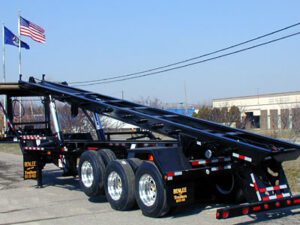
The conventional roll-off trailer uses a full-length structural frame that supports the container and hoist system. This is the traditional design that has been the industry standard for decades. Frame-style trailers are available in tandem axle (2-axle), tri-axle (3-axle), and multi-axle configurations up to 8 axles for specialized applications like Michigan’s higher weight allowances.
Advantages of conventional trailers include superior stability under heavy loads, the ability to accommodate longer containers (up to 43 feet with models like the BENLEE Bridge Master, a simpler mechanical design that’s easier to maintain, and better load distribution across the frame. The 6-year frame warranty offered by manufacturers like BENLEE reflects the durability inherent in this design approach. 6 Year Frame Warranty
Frameless Roll-Off Trailers
Frameless trailers eliminate the traditional full-length frame, instead using the container itself as a structural element when loaded. The trailer essentially becomes a set of axles, a hoist mechanism, and a stabilizer frame that relies on the container for rigidity during transport.
The primary selling point of frameless designs is reduced trailer weight, which can increase legal payload. However, this weight advantage must be carefully evaluated against several trade-offs: reduced stability when the container is partially loaded or when driving on uneven terrain, greater stress on the container itself (which can accelerate container wear), and limitations on the types and sizes of containers that can be safely transported. Frameless trailers also typically have shorter frame warranties (5 years or less) due to the higher stress concentrations in the stabilizer frame and the king pin plate. With 5 axle and more the 8 tires on the ground and the suspension will be over taxed. Framed vs frameless trailers
Bridge Master Roll-Off Trailers
The Bridge Master is an innovative design developed by BENLEE that optimizes payload capacity under federal bridge law weight limits. While traditional 80,000 GVW trailers are limited by how weight distributes across axle groups, the Bridge Master’s engineered wheelbase and axle positioning allows operators to carry significantly more legal payload than both conventional and frameless designs of comparable GVW rating.
The Bridge Master can accommodate containers up to 38 feet (and in some models up to 43 feet), making it an excellent choice for demolition, scrap, and high-volume waste operations where maximizing payload per trip directly impacts profitability. It represents the best of both worlds: the stability of a frame design with payload capacity that matches or exceeds frameless alternatives.
Two-Container (Double-Box) Roll-Off Trailers
Two-Container trailers carry two roll-off boxes simultaneously, dramatically improving efficiency for long-haul routes and operations that require multiple containers at a single site. These trailers use a specialized transfer system that allows the operator to load, unload, and position two containers independently.
The economics are compelling: one tractor and one driver can move two containers in the time it would take a single-box setup to make two round trips. For operations running regular routes of 50+ miles, the two-container trailer can reduce per-container transport costs by 30–40%.

Pup Trailers
Roll-off pup trailers are shorter, lighter trailers designed to be towed behind a roll-off truck, creating a truck-and-pup combination that can haul two containers. Available in “live” (wet) configurations with their own hydraulic system or “dead” (dry) configurations that rely on the truck’s hydraulics, pup trailers are popular for municipal waste collection, short-to-medium distance recycling routes, and operations where route density justifies the additional investment.

Multi-Axle and Specialty Trailers
In states like Michigan, where bridge law allows significantly higher gross vehicle weights, multi-axle roll-off trailers with 4, 5, 6, 7, or even 8 axles are common. These trailers can achieve GVW ratings up to 154,000 pounds, allowing operators to haul dramatically heavier loads than standard configurations. Multi-axle trailers require specialized knowledge of state-specific weight regulations, axle spacing requirements, and permit processes.
Other specialty configurations include drop-deck trailers (lower loading height for specific container types), crushed car trailers (designed for auto recycling operations), and gondola open top trailers for bulk material hauling.

Key Specifications: What to Evaluate When Choosing a Roll-Off Trailer
Not all roll-off trailers are built the same. Here are the critical specifications that separate high-performing equipment from trailers that will cost you money in downtime, maintenance, and lost payload:
- Gross Vehicle Weight (GVW) Rating: This is the maximum combined weight of the tractor, trailer, and payload. Standard configurations are 80,000 GVW for over-the-road use, with Michigan-spec models reaching 154,000 GVW. Your required GVW depends on what you’re hauling and where you operate.
- Trailer Weight (Tare Weight): The weight of the empty trailer directly reduces your legal payload. A trailer that weighs 1,000 pounds less than a competitor’s model gives you 1,000 additional pounds of payload on every single load. Over thousands of loads per year, this difference translates to significant revenue.
- Frame Warranty: Frame warranty length is a reliable indicator of manufacturing quality and confidence. In the industry, warranties range from 1 year (budget manufacturers) to 6 years (BENLEE, the longest in the industry). ACE offers 5 years. Many others offer 2–3 years. A longer warranty means the manufacturer is betting on their own build quality.
- Container Length Capacity: Make sure the trailer can accommodate the container sizes you use or plan to use. Standard trailers handle 20–40 foot containers. Some models (like the BENLEE Bridge Master) can handle containers up to 43 feet.
- Hydraulic System Specifications: Operating pressure (typically 2,000–2,200 PSI), oil flow rate (25–30 GPM), and hydraulic component quality all affect reliability and cycle speed. Quick-connect couplers (like Parker push-to-connect) prevent flow restrictions and speed up connections.
- Cable and Sheave System: Look for 7/8” cable minimum, sheaves with bronze bushings and machined grooves (which extend cable life), and a secure becket attachment. Cable replacement is one of the most common maintenance costs — better sheave design directly reduces this expense.
- Safety Features: Count the standard safety features. Some manufacturers include 25+ safety features as standard (hold-down straps, wheel checks, ABS, high-visibility grease points, sealed electrical connections, fast-flap mud flaps). Others charge extra for many of these same items.
- Paint and Corrosion Protection: The finishing process matters enormously for longevity. Look for complete sandblasting, primer, and oil-based epoxy paint application. Trailers that skip sandblasting or use lower-quality paint systems will show corrosion in 2–3 years.
Roll-Off Trailer Applications by Industry
Roll-off trailers serve diverse industries, and the optimal configuration varies by application:
- Scrap Metal Recycling: Heavy, dense loads require maximum payload capacity and extreme-duty frames. Bridge Master and conventional designs with high GVW ratings are preferred. Corrosion-resistant finishes are essential due to exposure to metals and processing fluids.
- Waste Management and Solid Waste: High uptime is critical since waste collection runs on tight schedules. Reliability, parts availability, and fast service response matter more than any other factor. Tarp systems are often required for DOT compliance.
- Construction and Demolition: Loads can be extremely heavy and vary widely in density. Extreme-duty trailers with multi-axle configurations handle the heaviest C&D loads. Durability in rough job-site conditions is essential.
- Environmental Services and Hazardous Waste: Specialized containment requirements, regulatory compliance, and safety features are paramount. Look for trailers with enhanced sealing and spill containment capabilities.
- Municipal and Government Operations: Procurement often requires specific certifications, warranty documentation, and Buy American compliance. Pup trailer configurations are popular for municipal route-based collection.
How to Choose the Right Roll-Off Trailer: A Buyer’s Checklist
When evaluating roll-off trailers for purchase, work through these considerations in order:
- Define your primary application (scrap, waste, C&D, environmental) and the container sizes you’ll use most frequently.
- Determine your required GVW based on typical load weights and the states/provinces where you’ll operate.
- Calculate total cost of ownership, not just purchase price. Include warranty coverage, expected maintenance costs, parts availability, and resale value.
- Compare trailer tare weights between manufacturers — every pound of trailer weight is a pound of payload you can’t carry.
- Evaluate the manufacturer’s parts and service support. Can you get parts shipped same-day? Is 24/7 emergency support available?
- Check the frame warranty length and what it covers. Ask what the warranty exclusions are.
- Count the standard safety features and compare them across manufacturers. Features that are “standard” at one manufacturer may be expensive add-ons at another.
- Ask about financing options. Many manufacturers offer direct financing or partnerships with equipment lenders.
- Request references from operators in your specific industry who run the equipment you’re considering.
Ready to find the right roll-off trailer for your operation? Contact BENLEE at 734-722-8100 or request a quote online With over 50 years of manufacturing experience and the industry’s only 6-year frame warranty, BENLEE builds roll-off trailers that deliver the reliability, payload capacity, and long-term value your business demands.