What Is the Best Roll-Off for Scrap Metal?
Choosing the right roll-off equipment is a big decision. The wrong choice costs you time and money. This guide answers the most common questions to help you decide.
Should I Get a Roll-Off Truck or a Roll-Off Trailer?
This is one of the first questions buyers ask. Both options work, but they are very different.
A roll-off truck is easy to drive. You only need a Class B license to operate one. But a new three-axle roll-off truck costs about $280,000 or more. That price includes a tarp and federal excise tax.
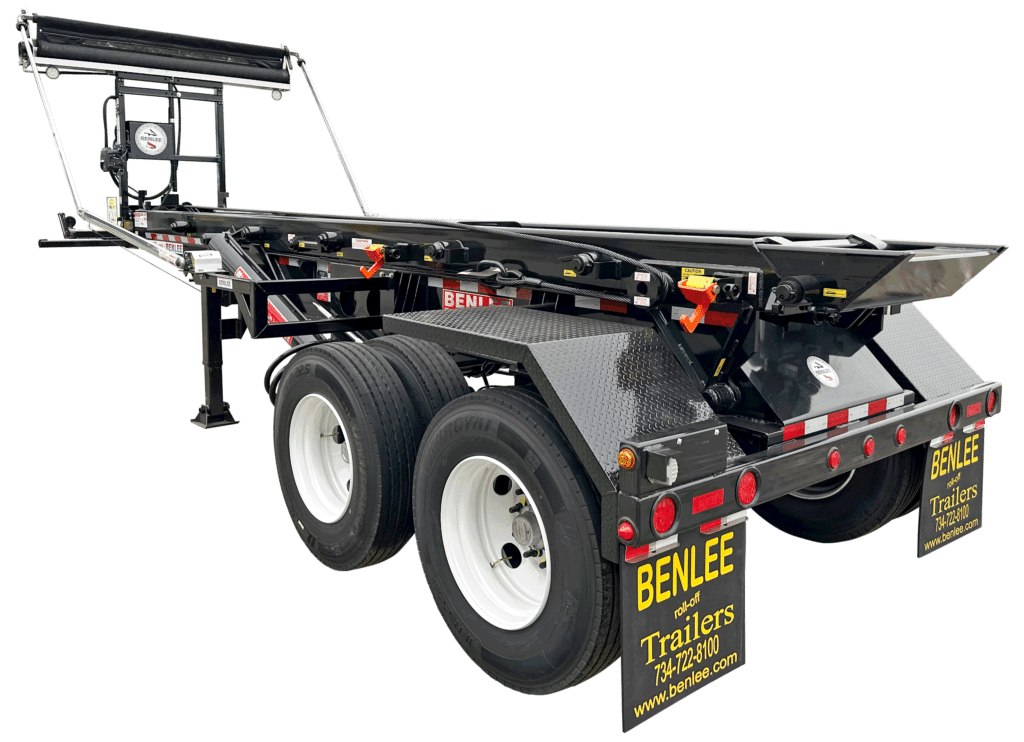
A roll-off trailer is a smarter choice if you already have a day cab. A Super Mini trailer is only 25 feet 11 inches long. Behind a day cab, the total length is about 36 feet. A roll-off truck is about 35 feet. The length is very similar. Because the Super Mini pivots, it makes it highly maneuverable. Also, it is almost ‘feather light”, yet it is a heavy hauler roll-off trailer.
The big difference is price. A Super Mini trailer costs less than $90,000. That saves you nearly $200,000 if you already have an underused day cab.
There are more advantages to the trailer setup. A skilled driver can get into tighter spots than a truck. When you are not using the trailer, the cab can pull a van trailer or flatbed. And the extra axle lets you carry more legal weight.
Should I Get a Framed or Frameless Roll-Off Trailer?
Choose framed. Here is why.
Frameless trailer makers claim their units carry more weight. That is not always true. The BENLEE Bridge Master is a framed trailer that proves this point.
The Bridge Master uses high-strength, thin steel. It weighs only about 200 pounds more than a frameless trailer. But it has a 20-inch longer bridge from kingpin to rear axle. That gives it an 80,000-pound GVW rating with a basic 210-inch day cab. A frameless trailer rates at only 78,500 pounds GVW.
Do the math: 1,500 minus 200 equals 1,300. The Bridge Master carries 1,300 pounds more payload than a frameless design.
Safety is an even bigger concern. When a frameless trailer lifts a load, the rear axles move closer to the drive axles. This shrinks the trailer’s footprint on the ground. At the same time, the center of gravity rises sharply. This double problem makes tipping much more likely. Scrap metal loads shift often. A smaller footprint and higher center of gravity is a very dangerous combination.
Also, as the hoist rises, most of the weight shifts to the rear tires and suspension beam. Those parts are not built for that kind of stress. This leads to early failures and expensive repairs.
Do I Need an 80,000 GVW Trailer?
Not always. Most operators use 20-, 30-, or 40-yard boxes. Unless the box is full of heavy steel, loads usually top out around 1- to 15 tons. In that case, a Super Mini or Super Mini Long trailer will get the job done for less money.
But if you want to maximize every load, then yes — an 80,000 GVW trailer is the right call. The Bridge Master is built exactly for that.
What If I Want to Run Over 80,000 GVW?
Overweight permits are available in many states, but the rules are different everywhere. In New York, you need at least a 34-foot trailer and a steerable lift axle. In other Northeast states, a three-axle setup without a steerable axle is allowed.
Always check your state’s rules before you buy. Getting this wrong can cost you in fines and downtime.
What If I Want to Carry Two Boxes at Once?
You have three options:
A dead (dry) pup trailer — No hydraulics. It tows behind your truck or another trailer.
A live (wet) pup trailer — Full hydraulics. It can load and unload boxes on its own.
A two-container trailer — One trailer designed to carry two boxes at the same time.
The right choice depends on how often you need two boxes and what your budget allows.
What If a Customer Overloads the Box?
Some customers put 70,000 to 90,000 pounds or more in a box. That is legal in Michigan but not in most other states.
For safety and compliance, ask the customer to unload to a legal weight before you move the box. If you work off-road and regularly need to move very heavy loads, the BENLEE Conventional roll-off trailer can pick up over 100,000 pounds.
What Makes BENLEE Trailers Safer and Less Expensive to Own?
BENLEE builds to a higher standard. Here are some key differences:
- 1-inch hoses instead of ¾-inch
- 1-inch steel hydraulic lines instead of ¾-inch
- Steel lines plated for rust resistance and better paint adhesion
- 12-inch sheaves instead of 10-inch
- 102-inch-wide axles instead of 96-inch
- Hoist-up and tail-up safety alarms
- Sealed hubs with 5-year synthetic grease
- Rollers and sheaves with grease grooves for longer life
These are not small upgrades. They add up to the absolute highest uptime, lowest repair costs, and a longest trailer life. BENLEE also backs their trailers with the industry’s only 6-year frame warranty. No other manufacturer comes close.
What If I Haul Light Loads Like Aluminum or Light Iron?
Light loads need bigger boxes to be profitable. You want to maximize volume, not just weight.
For aluminum, light iron, or shredded material, look at 80- to 90-cubic-yard boxes. Those boxes are 36 to 40 feet long or more. The BENLEE Bridge Master and Conventional trailers can go up to 44 feet. They are a great fit for large-volume, lightweight loads.
What If I Am in Michigan and Want to Go Very Heavy?
Michigan allows heavier loads than most states. Six-, seven-, and eight-axle trailers are your options. The seven-axle trailer is the most popular. But an eight-axle at 50 feet can legally carry over 100,000 pounds. Its GVW can reach 154,000 pounds.
Is It Safe to Buy a Used BENLEE Trailer?
Yes, in most cases. BENLEE trailers are built to last 30+ years. Some customers are still running units that are 45 years old.
BENLEE stocks over 99% of all replacement parts — rolls, pins, sheaves, cylinders, and tarps. You can call starting at 6:00 AM Eastern to order parts, or shop online 24 hours a day, 7 days a week. BENLEE also carries parts for Galbreath, Galfab, and Dragon trailers. So even if you run a mixed fleet, BENLEE has you covered at Online parts store
Can I Get a Wireless Remote Control?
Yes. BENLEE offers wireless remote controls as an option. More customers are choosing this feature every year. A wireless remote lets the driver operate the trailer from outside the cab. That makes tight-spot jobs safer and faster.
What Questions Should I Ask Before Buying Any Roll-Off Trailer?
Before you sign anything, get clear answers on these:
- What is the GVW rating and how was it calculated?
- What does the frame warranty cover, and for how long?
- Are replacement parts stocked and available fast?
- What axle width does the trailer use?
- What size hoses and hydraulic lines are installed?
- Does it have safety alarms for the hoist and tail?
BENLEE can answer all of these with confidence. Call starting at 6:00 AM Eastern or visit benlee.com for full product details.
Greg Brown
greg.brown@benlee.com
734-722-8100